

“I think with AI, we have to get that right.” Demis Hassabis, Google DeepMind Chairman
“We have to get it right the first time.” Geoffrey Hinton, AI researcher and Nobel Prize laureate
“We really need to get it right.” Dario Amodei, Anthropic CEO
“AI will be the best or worst thing ever for humanity, so let’s get it right.” Elon Musk, SpaceX CEO
The elephant in the room is that “to get AI right” is not just a technological, but above all an organizational problem. How the technology impacts our societies fundamentally depends on the organizational environment in which it is developed, applied, and owned.
And it is plain to see for anyone who cares to look that the organizational environment of the corporate logic is getting it wrong.
Cooperatives offer an alternative path of doing business
Last week I had the chance to participate in the “Cooperative AI” bootcamp in Rome, organized by the International Cooperative Alliance and Legacoop, the Italian Cooperative Association, and the Pico Foundation.
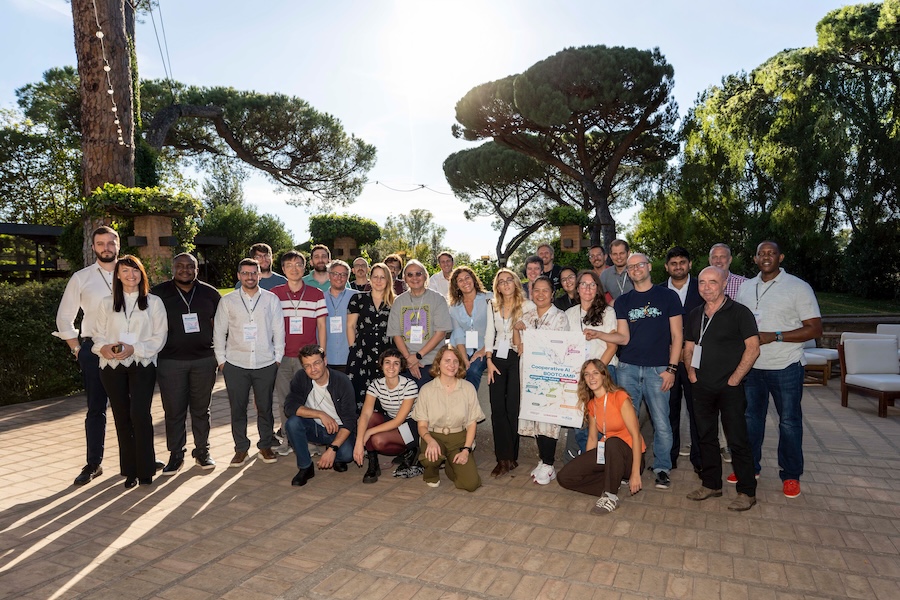
While the question of what a cooperative AI system could technically look like is still open, the participants agreed that it should be an AI that both supports human cooperation and reflects the cooperative principles.
For me, the central message of the Cooperative AI Bootcamp was that the major bodies of the cooperative movement are realizing the scale and urgency of the challenge to find an appropriate response. As a next step, separate working groups will look into the needs of cooperatives and coordinate inter-cooperation.
Many of today’s cooperatives are rooted in communities and have access to local data and real human value creation, while being completely disconnected from the current trajectory of AI development.
In my view, this opens a real chance for the cooperative movement: finding a way to “harvest” the unique data that local cooperatives have access to, while making sure that the value creation and control over these data remain fully in cooperative ownership.
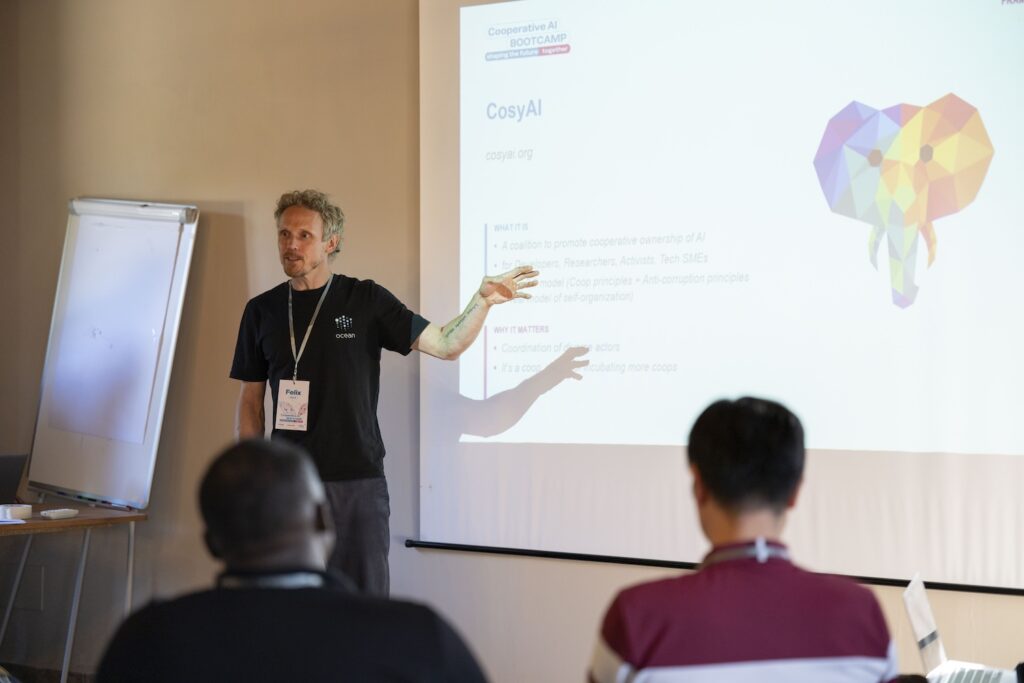
One example we looked into was community data centers as a way for local cooperatives to help their communities own and control their part of the AI value chain. We can develop an organizational template and a technical toolkit for communities, so that they can decide to build data centers on their own terms and in line with their needs.
This is one of the core avenues we are planning to take at CosyAI. CosyAI is an initiative to bring AI into cooperative ownership, from the data and the compute infrastructure to the models themselves. It is currently stewarded by Cosyland e.V., a nonprofit in Berlin, and we are preparing the registration of a multi-stakeholder European cooperative (SCE) with open global membership.
AI improves faster than most people realize
The response of the cooperative movement comes right on time, as AI has reached a stage where it is powerful enough to undermine the business models of even large, established companies.
Every other week comes another AI model that breaks some new benchmark record. But to get a sense of the real shift that is happening this year, it helps to look at what is happening in software development.
A prominent example is David Heinemeier Hansson (aka DHH), the creator of the web framework Ruby on Rails. In an episode of the Lex Fridman Podcast in 2025, he was still quite skeptical of “vibe coding”. One year later on the same podcast, his enthusiasm about agentic coding reached an extreme where he described himself as being “in a state of delirium”.
He runs several AI agents in parallel to build his own Linux distribution, Omarchy, and says he has not written any of the code in its latest release by hand. His role has changed from writing code himself to coordinating agents, even though he is considered one of the best coders in the world.
Acting while there are still bottlenecks
A major bottleneck, and the real reason why this has not led to a complete breakdown of the digital economy yet, is token costs. In order to achieve these results, AI agents have to try the same task over and over, test the results, and try again. This burns millions and billions of tokens and consequently enormous amounts of energy and resources.
But is this not exactly the claim of the proponents of the “AI hype”, who argue that we should invest all available capital in building more data centers and compute power, so that the token bottleneck can be overcome?
There are two main reasons why this argument is flawed:
The first is that we cannot make any reliable predictions about the efficiency gains that future innovations in AI will bring. Given the enormous amounts of resources concentrated on improving AI, major breakthroughs are more likely than ever. This means that we might simply need much less compute power to achieve the same results.
The second reason is that right now each of the leading AI companies is evaluated as if it will “own the market” of token production. But it is by no means clear whether there will be a quasi-monopoly for AI, and much less clear who will be that monopolist.
A second major bottleneck for using AI to automate larger parts of the economy is the data needed to define verifiable outcomes for specific work tasks. Software development is a domain with relatively easily verifiable outcomes, because an agent can check for itself whether the code runs and whether the replica behaves like the original. Most other parts of the economy are much fuzzier. To automate them, AI companies need data about how people actually do this work and what success means specifically for each task.
Currently, big tech corporations like Meta, Microsoft, and SpaceX (which owns xAI and Grok) are offering “free” personal agents to their users, thereby opening up an avenue for themselves to grab these data at large scale.
Turning these frustrating observations into chances
Meric, a member of our CosyAI founding team, put it in clear words: “We must not be paralyzed by all this disheartening news.”
In fact, the existence of these bottlenecks creates an opening for the cooperative movement.
We can offer a reliable and trustworthy alternative to this hyped-up race to centralize power. And we can build an AI infrastructure that embraces the potential future efficiency gains in AI technology.
Such efficiency gains are likely to make smaller and more distributed infrastructure good enough for many of the tasks we need AI for. This strengthens the case both for community-owned hosting and data centers and for specialized, smaller AI systems based on data that is in the hands of the communities. At the same time, these gains would speed up the shift we already see in software development. Once the token bottleneck is gone, the value would move to the owners of the infrastructure at full speed. So we need to settle the ownership question while the bottleneck still exists.
Much of the data about how fuzzy work is actually done sits with the people who do this work. This is where cooperatives can use their specific strength. If we offer cooperatively owned personal agents that guarantee full data sovereignty, these data stay with the people who create them. Communities can then decide whether and how to use them, for example to train specialized AI systems they own themselves.
If we manage to coordinate now and unite as many smaller players as possible, we can break ground for a different technological and organizational path towards a future where we as humans can still thrive and decide what we want our lives and living environments to look like.
Confronting the AI investment hype
The initiative to strengthen the cooperative response to AI comes at a moment when the risk of the AI investment bubble bursting receives widespread public attention. Corporate players are increasingly using debt to finance the extreme race towards building more and bigger data centers, and in some cases, like CoreWeave, investors are already stepping back.
Cooperatives offer a proven alternative to the growth addiction induced by the corporate logic that is behind these race dynamics. The major question is how we can raise significant capital to build alternative AI infrastructure without fueling the same risks that corporate AI players are currently pushing onto our societies worldwide.
With CosyAI, we are planning to run the world’s first 1-billion-euro crowd-investing campaign. By setting this ambitious goal, we aim to create the momentum for the transition into a more balanced development path in AI. We do need substantial funds to finance the collectively owned AI infrastructure we are envisioning. Of course, we don’t need to raise this sum in one go. We will do this step by step, each time bringing together more people who share our cause.
The crucial difference from the corporate race dynamics is that we build AI infrastructure based on real, existing demands of our members, rather than based on speculation about future profits from automating the economy. People and companies can join the cooperative because they actually want to use AI that runs on hardware they co-own and control. At the same time, our specific Coop 3.0 model is designed to protect our approach from corruption and to ensure that anything we build is rooted in and accountable to our members.
Help make it happen
At CosyAI, we are committed to contributing to the collective response of the global cooperative movement.
Our focus right now is founding and registering our cooperative at the European level, which will allow us to start operating. Our current roadmap begins with cooperative cloud compute and easy-to-set-up personal AI agents with a focus on data sovereignty. Once we have a running model for safe AI infrastructure in place, we will support the creation of community data centers.
We are currently working to reach our goal of 100 founding members by the Solidarity AI conference in Bangkok on November 12 to 15, 2026. You can now make a non-binding pledge to join our cooperative as an individual member or as an organization.
It would also be an enormous help if you take 15 minutes to complete our survey, which will help us focus on our (potential) members’ needs and concerns.
And if you have time to spare, you can join one of our volunteer teams.
If you are concerned about the current path of AI and want to do something about it, let’s team up. Cooperation has always helped humanity to move forward and now is the time to join forces across borders and classes.
Credits for the photos in the header picture:
Elon Musk By Gage Skidmore, CC BY-SA 4.0
Dario Amodei By TechCrunch, CC BY 2.0
Demis Hassabis By John Sears – Own work, CC BY-SA 4.0
Geoffrey Hinton By Cmichel67 – Own work, CC BY-SA 4.0