
This is the first of four posts in which I share the founding ideas behind CosyAI. After that, this blog will be a place where projects, insights, and news are shared by the many other people who are building this with us.
I hope you will join in making this happen.
Felix Weth
Founder of CosyAI
A new story
The famous AI models we have today were trained on thousands of years of human learning and creation. At the moment, most of the value this technology creates and most of the power it brings is controlled by a few big tech corporations.
We are told a story that the “AI arms race” is inevitable. According to this narrative, the AI labs are pushed to take any risk and use all resources they can possibly get to be the first to build the “artificial superintelligence” that will transform everything.
This is joined by the geopolitical narrative: Because superintelligent AI will bring unprecedented power, the question of who will control it becomes a competition between the major global political powers, in particular the U.S. and China. Each side portrays the “others” as the “bad ones” who they need to outcompete so that they won’t take advantage of them.
CosyAI is about a different story:
We, the people, can take ownership of AI and decide collectively where we want to go with it. We free ourselves from the pressures of the „arms race“ and the geopolitical narrative. In order to do that, we create CosyAI as a cooperative platform that connects researchers, developers, activists, cooperatives, and small and medium companies that share the wish for a future that is driven by human values, rather than corporate incentives.
We start from the simple question: What do we really want?
By we, I mean all of us humans globally. Of course, humanity is incredibly diverse and the goal cannot be to fit us all into one box. But we do have some basic things in common that we can unite around. In order to even ask this question, we need to live, to be free, and to have brains that function properly.
No sane person wants a World War III fought by autonomous weapon systems that makes our planet uninhabitable. No sane person wants a sci-fi scenario where out-of-control superintelligent machines suppress all humans. The vast majority wouldn’t want a completely unequal world where most of us are trapped in extreme poverty or slavery. Most also wouldn’t want a world where our brains are “enhanced” (i.e. manipulated) so much that we wouldn’t recognize ourselves as humans anymore.
We don’t need to accept defeat
Yes, big tech corporations have accumulated enormous resources and power. But we don’t need to accept that they get to decide the rules of the game. After all, the vast majority of us just wants to live a peaceful, fulfilling live, in communities we can trust and respect. The more clearly we stand up for the capacity for trust, love, and cooperation that is at the core of the human species, the more momentum we will build.
If we take this seriously, it becomes clear that the current challenges we are facing with AI are not technological problems, but organizational problems. Right now, technological development is driven by organizations with built-in incentives that are not aligned with the wellbeing of humanity and healthy ecosystems on planet Earth.
From this perspective, the current advancements in AI put us in an unprecedented situation. For the first time in human history, we have a chance to overcome these systemic flaws, because we can use this technology to coordinate a transformation of our most powerful organizations without needing violence.
AI comes with enormous risks and is currently clearly organized the wrong way. But the paradoxical situation is that the transformative shake-up it will bring to our societies offers a chance to reorganize ourselves in a smarter, more balanced way that is more aligned with our deeper human values.
We don’t start from zero
To find this alternative way, we don’t need to start from scratch. We can build on more than 150 years of learnings from the cooperative movement. In addition to that, our collective wisdom in spiritual and holistic self-development builds on a much longer experience. Again and again, humanity has found a huge variety of ways of building and maintaining healthy and thriving local communities, which we can build on now.
This is complemented by extensive experience in building human-aligned approaches to technology. The open source movement has built up decades of knowledge on how to create and coordinate software and hardware development responsibly. Hundreds of thousands of people have worked on technical tools to support democratic governance and to avoid unaccountable power centralization and corruption.
Among us, we have the knowledge and wisdom for building organizations that can redirect AI development in a way that is really aligned with us humans.
For this, we don’t need to wait for our governments to decide on effective regulation. There is a good argument to be made that democratic governments have no chance to regulate AI development, given the complexity of the technology, the complexity of democratic decision-making, and the information asymmetries between governments and the AI labs.
But we can start right now, as the people who we are today, if we unite around our common challenge and common human core to guide us.
The first round
When ChatGPT came out, I thought “Great! Finally we can make use of everything we have learned in more than ten years of platform cooperatives.” Platform cooperativism is a movement where thousands of projects worldwide work on bringing digital platforms into cooperative ownership.
“Surely,” I thought, “everyone will see now that we can’t leave AI to the same old corporate games. Platform coops can finally take a lead role in advancing this technology, instead of just reacting to existing tech and markets that have already been captured.”
It seemed also clear to me that the organizational structure of OpenAI, which let in corporate power through the backdoor in the form of Microsoft’s investment, wouldn’t work as a safeguard, and would be easily corrupted.
And so I started CosyAI. The simple idea was: Let’s build a coalition of all who really care. And let’s make this the one big thing we can all unite around. I started reaching out to people in my network and presented the project at a major conference of Cooperatives Europe, where the leaders of large cooperatives gathered. In November 2023 I had the chance to present CosyAI at the Roots of Resilience conference in India, giving me the chance to connect with researchers and practitioners from the other side of the globe.
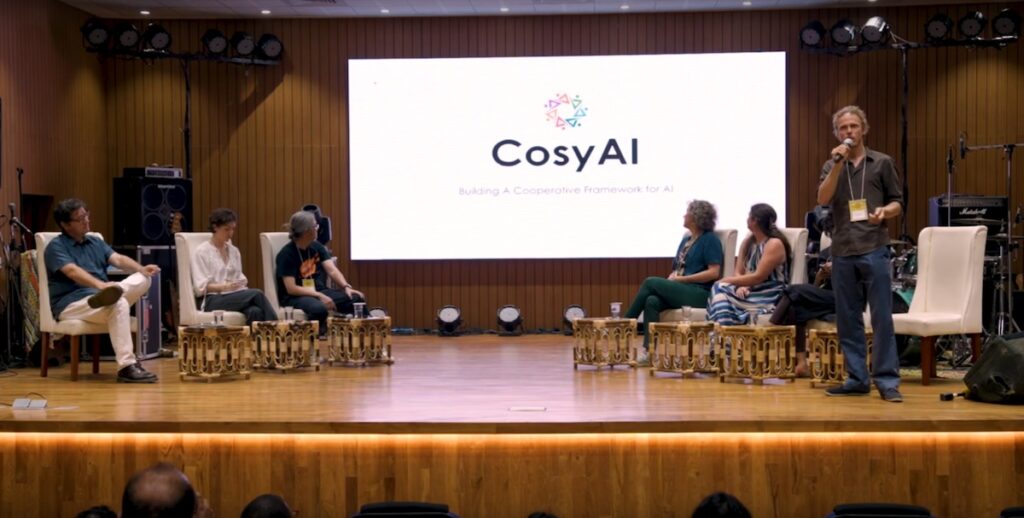
But while almost everyone liked the idea, no one was prepared to commit substantial resources. I did manage to build up a group of people who met weekly online and we even prepare a crowdfunding campaign. But I did not manage to get people to go all in, and in early 2024 I decided to put the project on hold.
At this point, I had already overstretched my own capacities and having used resources of my own small software company, it ended up going bankrupt. I decided to first rebuild my own strength and take the time to get myself a more solid foundation of knowledge around AI.
New momentum for CosyAI
Now, two years later, the world looks different. Most people are aware that there’s something going seriously wrong with AI development. Anyone who is interested in the responsible use of technology has their social media feeds full of warnings about the AI hype.
And no matter where people stand politically, everyone can agree that the current global political situation is a mess.
Last November, I presented CosyAI at the Cooperative AI conference in Istanbul, Turkey. This time it felt different. It was encouraging to see how many organizations, researchers, and activists were working on the topic. Meanwhile, more than 700 people and organizations had signed up on our landing page.
I also realized that I myself had become more radical. We don’t have time left for half-hearted compromises and superficial professionalism. We need to leave the old corporate logic behind. This is about preserving the very core of our humanity, and we need to fight for this before the levers of power have completely shifted.
The real power shift
The real power shift will happen when the unique value of employees and workers evaporates through automation. Today, much of this value is in the knowledge and skills that are still in the heads and bodies of us humans. This gives us the ultimate leverage over our companies. Most company’s activities would still come to a halt if all human workers stopped working. Once machines are capable of continuing the work on their own, that leverage is gone for good.
This risk is compounded by the advances toward fully functional autonomous weapon systems. If power can be enforced through violence without needing human soldiers and police, there is no leverage left to prevent a total breakdown of human freedom.
These threats are now widely discussed. People differ passionately about how imminent the risks really are. Some say 1 or 2 years, others say 10 or more. But if we keep the current direction, we will eventually get there. If we remain clear and uncompromising about the fact that corporate AI leads to complete power centralization and the marginalization of (almost) everyone, we can use this as momentum to open a different path.
It’s about who owns the infrastructure and data
The leverage that remains when human work is not needed lies in the infrastructure and data pipelines that AI runs and learns on.
When I started CosyAI, I thought the challenge was about owning the models. But the models evolve constantly, and open-weight systems have turned out far more capable than I expected three years ago. Of course, we also need to reclaim control over the software and algorithm layers. But the real shift will come when the underlying infrastructure is owned and controlled by the people.
Currently, most of the big data centers are owned by big tech corporations. This is why CosyAI has the explicit goal of enabling cooperative ownership of the hardware layer. In the beginning, we focus on co-owning decentralized clusters of chips and servers. Further down the road, we will also move into chip design and production.
The other crucial component is data. Right now, data is still leverage. Much of the value in companies comes down to the data only they have access to. The more data is centralized by large corporations, the harder it becomes for smaller companies to stay in business. At the same time, the big AI labs are working on ways to generate synthetic data and to let the AI improve itself without any input from humans.
If we want our own work and efforts to remain valuable, we need to reclaim the power of our data as soon as possible.
Our strength is trust
If we build companies with sincerely designed cooperative structures, we can enable new levels of trust. This trust is what makes us stronger than the big tech incumbents despite all their current power and resources, since they are inherently restricted by their corporate incentive structures. They cannot escape these structures, which will always make them favor their own growth over human values, whatever the storytelling. More and more people and smaller companies realize that giving data and resources to these corporate players comes at a price that is too high to pay.
Trust is what gives CosyAI (and all similar organizations) an “invincible moat”, since the only way for corporate players to copy it would be to adopt a similar cooperative model, which would simply advance our goal.
The organizational design of CosyAI explicitly makes sure that it has no built-in pressures to “own the whole market”. Instead, it is designed around the common purpose of making AI cooperatively owned.
Putting the human question at the center
The current AI labs all adopted the same old Silicon Valley paradigm: “We can solve our problems with technology and therefore need to mobilize all available resources to push through technological innovation.” This paradigm is rooted in a mindset of fear-driven individualism. Its “solutions” try to fix our existential discomforts through ever more consumerism and perceived control, a promise that can never be truly fulfilled.
CosyAI aims to transcend this paradigm. What is needed today is organizational innovation that enables an approach to technology that really serves us humans.
The corporate idea of professional life asks us to leave our humanity at the door and take on a role that is defined by the organization’s needs. If AI remains in the hands of big tech corporations and startups that subscribe to the same old venture capital logic, it will accelerate exactly the same patterns.
This is why CosyAI is based on the “cosy” concept, which stands for “cooperating sincerely”:
How can we organize ourselves in a way that nourishes and preserves our capacity for sincere cooperation? How can we embed the protection of our human core into the DNA of the organization, rather than designing incentives in a way that disconnects us from who we really are?
The good thing is that if we build companies that are more aligned with our deeper selves, it just feels better to work for them.
Aiming high, starting on the ground
Of course, the question is how to get there, in particular given the insane speed of AI development and the billions of dollars invested by big tech.
The short answer from CosyAI is: By uniting all people and organizations globally who want a responsible, human-aligned development and use of this technology. We can no longer afford silo-thinking. Instead, we need to coordinate and pull in the same direction. No-one has the perfect solution. But together, we can reclaim ownership of AI for the people and decide collectively where we want to go with it.
We don’t need to start from this big goal or to reach everyone from the start. Rather, we start by offering an organizational framework for making this happen. We build a solid ground with all who are ready to start now, and design our organization in a way that all others can join along the way.
An important part of this is that we don’t try to reinvent things from scratch. Rather, we connect and support what has already been built and conceived by thousands of open source developers, researchers, and value-driven NGOs and companies.
The first step of building a coalition is already done. Our next step is to register a legal cooperative so that new partners can join and coordinate within a clear structure and reliable processes.
Offering alternatives and funding the transition
From here, we focus on offering concrete products and services with the help of our existing members and partners. We will start with a managed AI workspace that people and communities can use today. The next steps will include offering small, specialized AI models within a safe infrastructure that enables data sovereignty.
Depending on the partners who join, we will take on more ambitious goals: building a European compute cluster owned by the people, a technical framework for local community data centers, and a cooperative AI lab that supports the development of AI systems built on new, cooperative paradigms and a more responsible use of resources. Of course, we will review and revise our goals along the way according to the needs of our members.
To fund this, my proposition is to announce the world’s first “billion-euro-crowd-investing campaign” that will make clear that we’re serious about redirecting the path of AI development. Once again, we won’t need to reach that goal in one sprint. Rather, we can get there step by step, setting intermediate funding goals in line with the progress of our coalition building and the people and organizations that join.
In the long run, I envision CosyAI (together with a diversity of cooperative partners) creating an “AI safe space” for anyone who wants to live protected from technologies that are merely symptoms of big tech power games and geopolitics.
What’s coming next
In a next post, I will dive deeper into the question of why cooperative ownership of AI is a practical necessity rather than an ideal.
The third will look into the question of how we can build something this big without it becoming just another power center. That post will describe a concrete organizational design that draws from the rich sources of organizational innovation that we already have at our disposal to create an organization that protects and nourishes our human core.
My fourth post will put forward ideas of what a cosy AI could actually look like, an AI built to be aligned with human wellbeing from the ground up.
Join us
You are warmly invited to join this undertaking right now. While I outlined my vision here, which I developed in discussions with many, many people, every new perspective is welcome.
CosyAI thrives by being an open platform for sincere cooperation. We welcome contributions from anyone who shares the sense that we need a more responsible, more human-aligned approach to AI development than we are currently seeing.
The essence of the model and strategy that I’m proposing is a system that allows for decentralized contributions and spontaneous coordination wherever fruitful. You can join the coalition as an individual activist, developer, or researcher, or as an organizational partner. Already today, you can help with active contributions or by making a pledge to become a founding member with a share in the cooperative.
If we want AI to be owned and controlled by us, the people, we need to start claiming ownership now.
It would be great if you help make it happen.
You can join today to contribute actively.
You can also make a (non-binding) pledge to become a founding member of the cooperative.
And you can support our (currently all-volunteer) work with a donation through our Open Collective account.